
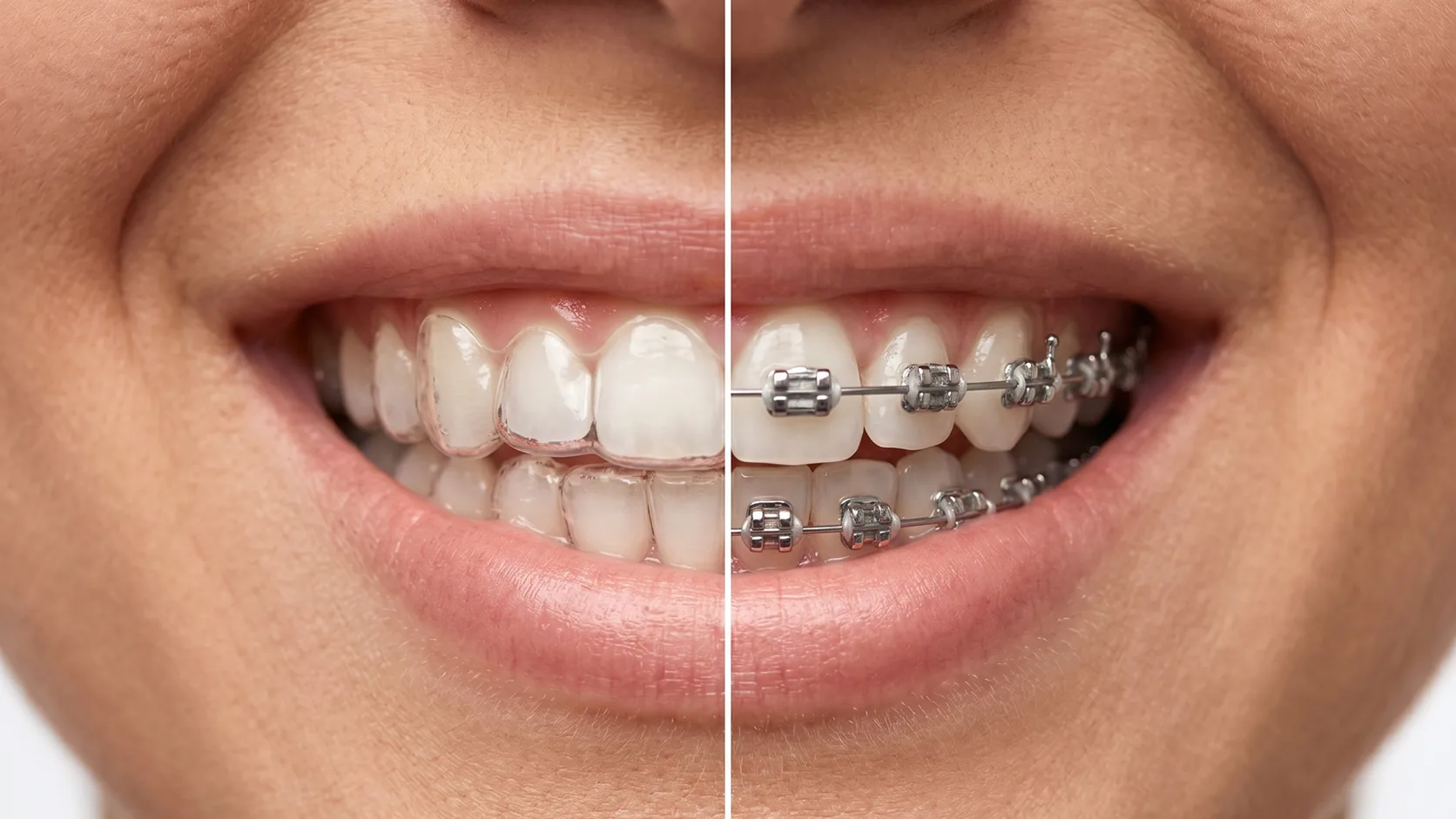
You have been told you need orthodontic treatment, and you are now comparing options. Invisalign and metal braces are the two most commonly compared orthodontic treatments in Abu Dhabi — and the honest answer is that neither is universally better. The right choice depends on what your teeth actually need, how complex your case is, your lifestyle priorities, and your commitment to the compliance requirements each option demands. This guide gives you the clinical comparison to make that decision clearly.
For patients who have already researched the topic broadly, the guides on Invisalign vs braces in Abu Dhabi and metal braces vs ceramic braces offer additional depth. The complete overview of orthodontics in Abu Dhabi covers all treatment options including ceramic braces for patients who want a less visible fixed option.
How Invisalign and metal braces work differently
Metal braces use brackets bonded to each tooth connected by an archwire that the orthodontist tightens periodically. The wire exerts continuous, calibrated pressure on the teeth, moving them gradually toward their target positions. The system is fixed — it stays on the teeth 24 hours a day throughout the treatment period and cannot be removed by the patient.
Invisalign uses a series of custom-made clear plastic aligners, each designed to move the teeth by a small incremental amount. The patient wears each aligner for one to two weeks before progressing to the next in the series. The aligners are removed for eating, drinking anything other than water, and oral hygiene. The system is patient-controlled in a way that fixed braces are not — which is both its key advantage and its primary compliance requirement.
Side-by-side comparison
| Factor | Invisalign | Metal braces |
|---|---|---|
| Visibility | Nearly invisible | Visible metal brackets and wire |
| Removable | Yes — removed for eating and cleaning | No — fixed throughout treatment |
| Compliance required | 22 hours/day wear — patient responsibility | None — fixed to teeth |
| Oral hygiene | Easier — brush normally after removing | More effort — cleaning around brackets |
| Dietary restrictions | None — remove aligners to eat anything | Avoid hard, sticky, crunchy foods |
| Case complexity | Mild to moderate; some complex cases | Mild to severe — widest range |
| Treatment duration | 6–18+ months (compliance-dependent) | 12–24+ months |
| Clinic visits | Every 6–10 weeks | Every 4–6 weeks |
| Comfort | Generally more comfortable | More irritation, especially early |
Which cases suit Invisalign and which need metal braces?
The most important factor in deciding between the two is the clinical complexity of your specific case — not aesthetic preference. Invisalign has become significantly more capable over successive product generations and can now treat cases that would previously have required fixed braces. However, certain clinical situations still favour metal braces.
Cases where Invisalign works well
Mild to moderate crowding, spacing between teeth, minor bite issues, and relapse cases where previously straightened teeth have drifted are all well within Invisalign’s capabilities. Adults and older teenagers with the discipline to maintain 22 hours of daily wear typically achieve outcomes comparable to fixed braces in these case types. The digital treatment planning process also lets patients see a simulation of the projected outcome before beginning — something fixed braces cannot offer in the same way. More detail is available in the guide on understanding Invisalign duration and timeline.
Cases where metal braces have the clinical advantage
Severe crowding, complex bite corrections (deep bite, open bite, significant crossbite), certain rotations, and cases requiring precise control of multiple tooth movements simultaneously often achieve more predictable outcomes with metal braces. The continuous force applied by a properly tightened archwire is more consistent than patient-controlled aligner wear, particularly in cases where movement precision is critical. For younger patients or those with a history of poor compliance with medical instructions, the fixed nature of braces is a practical advantage — the treatment progresses whether or not the patient remembers their responsibility.
The compliance factor: what most patients underestimate
Invisalign’s removability is its most appealing feature for most patients — and its biggest clinical risk factor. The aligners must be worn for a minimum of 22 hours per day to move teeth according to the treatment plan. Removing them for extended periods — even a few extra hours daily — slows tooth movement, extends the total treatment time, and can cause mismatches between the aligner and the tooth positions, requiring additional aligner stages to correct.
Metal braces require no compliance beyond attending adjustment appointments. The wire does the work regardless of the patient’s daily choices. This makes braces the more reliable choice for patients who are realistic about their likelihood of maintaining strict aligner wear, and for younger teenagers whose commitment cannot be guaranteed.
Oral hygiene: the practical difference during treatment
With Invisalign, oral hygiene is simpler — remove the aligners, brush and floss normally, then replace them. The risk of plaque accumulating around brackets does not apply. The one discipline required is cleaning the teeth thoroughly after every meal before the aligners go back in, to prevent trapping food debris against the tooth surface.
Metal braces require more effort. Brackets and wires create additional surfaces for plaque to accumulate and make flossing more time-consuming. Patients who are already diligent about oral hygiene manage this well. Those with less consistent hygiene habits are at higher risk of decalcification — white spot lesions — around brackets during treatment. A practical guide to professional braces cleaning explains the recommended routine for patients with fixed appliances.
Is Invisalign suitable for teenagers?
Invisalign offers a product specifically designed for teenagers, including compliance indicators built into the aligners that show how consistently they have been worn. The clinical outcomes are comparable to braces for cases in the mild to moderate range. The key question is whether a given teenager has the self-discipline to maintain daily wear. This is something the orthodontist and family should discuss honestly — the answer varies significantly from one patient to another.
Thinking about orthodontic treatment in Abu Dhabi?
At Al Safwa Medical Center in Bani Yas, the orthodontics team assesses each patient’s case clinically before recommending a treatment approach. The recommendation is based on what the teeth need — not on a preference for either system. A digital scan and treatment simulation can be provided for Invisalign cases so patients understand what to expect before committing.
- Invisalign in Abu Dhabi
- Metal braces Abu Dhabi
- Ceramic braces Abu Dhabi
- Orthodontics Abu Dhabi
- Book a consultation
The Al Safwa orthodontics team will explain which option suits your case and why during your first assessment visit.
Frequently asked questions
Is Invisalign more expensive than metal braces in Abu Dhabi?
In most cases, Invisalign costs more than standard metal braces. The difference reflects the digital planning technology and the cost of manufacturing the full series of custom aligners. The exact cost for each option depends on the complexity of the case and the number of aligners or adjustment appointments required. Your orthodontist will provide a cost breakdown after the initial clinical assessment.
How long does Invisalign take compared to metal braces?
Treatment duration varies by case complexity and, for Invisalign, by how consistently the aligners are worn. Simple cases with Invisalign can be completed in six to twelve months. Metal braces for moderate to complex cases typically run twelve to twenty-four months. The most significant variable with Invisalign is patient compliance — consistent 22-hour daily wear keeps the treatment on schedule; inconsistent wear extends it.
Can adults get metal braces in Abu Dhabi?
Yes. There is no age limit for orthodontic treatment. Adults with healthy teeth and gums are candidates for both metal braces and Invisalign. Many adults choose Invisalign for aesthetic reasons, but metal braces remain appropriate and effective for adult patients with complex cases or those where the fixed nature of the appliance provides a clinical advantage.
Do I need a retainer after Invisalign or braces?
Yes — a retention phase is essential after any orthodontic treatment, regardless of the system used. Teeth have a natural tendency to drift back toward their original positions after active orthodontic movement. A retainer — either removable and worn nightly or a fixed wire bonded to the back of the teeth — maintains the achieved result. Skipping retention is the primary cause of orthodontic relapse.
What is the difference between ceramic braces and Invisalign?
Ceramic braces use tooth-coloured brackets and are fixed to the teeth like metal braces, making them far less visible than metal while retaining all the advantages of a fixed appliance — continuous force, no compliance requirement, suitable for complex cases. Invisalign is removable and nearly invisible. The choice between ceramic braces and Invisalign is often a matter of case complexity and whether the patient needs or prefers a fixed or removable appliance.
