
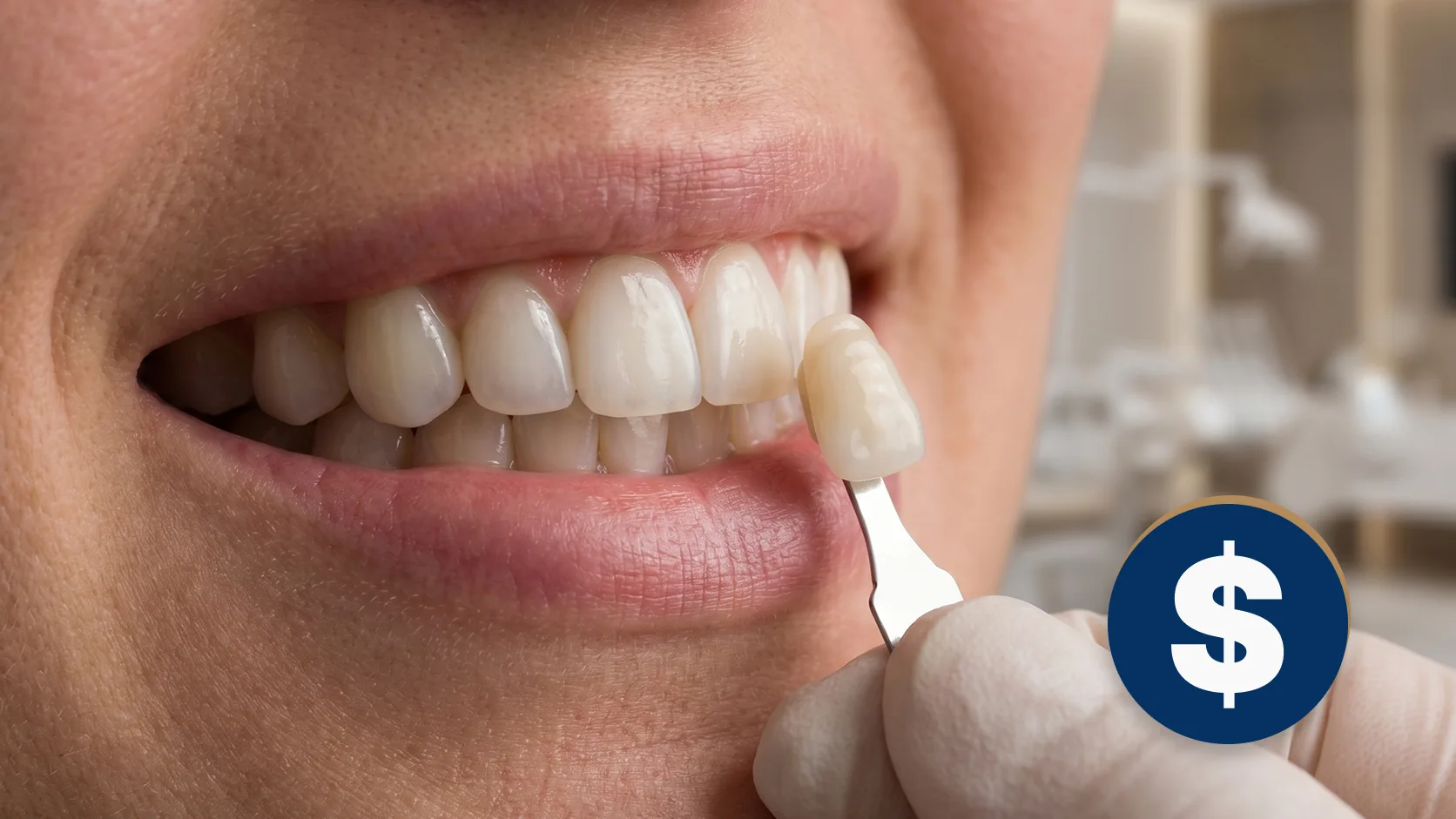
Dental veneers are one of the most effective cosmetic dental investments available — and one of the most frequently misquoted. Understanding what the price actually covers, why it varies so significantly between clinics and cases, and what you should expect to pay for a result you will live with for fifteen or more years is essential before you commit to any treatment. This guide covers the complete picture: realistic veneer prices in Abu Dhabi, the difference between Emax and porcelain veneers and why it matters for both aesthetics and cost, what a complete veneer quote includes, and what payment options are available. If you are researching veneers in Abu Dhabi, start here.
A veneer is a thin shell of ceramic material — typically 0.3 to 0.7 millimetres thick — that is bonded to the front surface of a tooth. It changes the tooth’s colour, shape, length, and surface texture simultaneously. For patients whose concern is primarily cosmetic (discolouration that does not respond to whitening, worn or chipped edges, minor spacing or shape irregularities) and whose teeth are otherwise healthy, veneers are often the most efficient and longest-lasting solution. The cosmetic dentistry team at Al Safwa Medical Center in Bani Yas, Abu Dhabi, designs every veneer case individually based on the patient’s teeth, face, and aesthetic goals.
Veneers price in Abu Dhabi: realistic cost ranges per tooth
Veneers in Abu Dhabi typically cost between AED 1,400 and AED 3,500 per tooth, depending on the material, the laboratory, the complexity of the case, and the experience of the cosmetic dentist. Here is a breakdown by material type:
| Veneer Type | Cost Per Tooth in Abu Dhabi | Lifespan | Best For |
|---|---|---|---|
| Emax (lithium disilicate) | AED 1,800 – 3,500 | 15–20+ years | Maximum translucency, most natural result |
| Porcelain (feldspathic) | AED 1,600 – 2,800 | 10–15 years | Excellent aesthetics; slightly more technique-sensitive |
| Composite veneers (direct) | AED 600 – 1,200 | 5–7 years | Single visit; more reversible; less durable |
| Zirconia veneers | AED 1,500 – 2,500 | 15+ years | Highly durable; less translucent; better for posterior use |
For a standard Hollywood Smile-style transformation of eight to ten upper teeth using Emax veneers, patients in Abu Dhabi typically invest AED 14,400–35,000 depending on the number of teeth and the per-tooth rate at the clinic. A minimal treatment of four to six upper front teeth costs AED 7,200–21,000 at these rates.
Emax vs porcelain veneers: which is better and what is the price difference?
The two most commonly used veneer materials at reputable cosmetic dental clinics in Abu Dhabi are Emax and feldspathic porcelain. The question of which is better does not have a universal answer — they have different properties and are suited to different clinical situations. Understanding the difference helps you ask the right questions when comparing quotes.
Emax (IPS e.max lithium disilicate)
Emax is a pressed ceramic material manufactured by Ivoclar Vivadent. It has become the dominant choice for anterior veneers at premium cosmetic clinics globally because of its unique combination of high translucency and high flexural strength. The translucency means Emax veneers can be made to look almost identical to natural enamel — catching light in the same way, showing depth and gradation of colour. The strength means they are significantly more resistant to chipping and fracture than traditional feldspathic porcelain, particularly in thinner preparations where the material needs to be very thin (0.3–0.5 mm) to avoid excessive enamel removal.
Emax veneers cost more than feldspathic porcelain primarily because the material itself is more expensive, the fabrication requires specific pressing and characterisation techniques, and the results are consistently at the higher end of the aesthetic spectrum. At Al Safwa Medical Center, Emax is the standard material for anterior veneers.
Feldspathic porcelain veneers
Traditional feldspathic porcelain veneers are layered by hand by a skilled ceramist and can produce exceptional aesthetic results, particularly in skilled hands. They are slightly more technique-sensitive in fabrication and more fragile than Emax, but in the right hands they can achieve a level of colour characterisation and translucency that matches or exceeds Emax. They are typically used by ceramists who specialise in cosmetic laboratory work and are comfortable with the material’s properties.
The clinical choice between Emax and feldspathic porcelain is made based on the specific case requirements — tooth colour, preparation depth, shade matching complexity — and the preference of both the cosmetic dentist and the ceramist. Both can produce exceptional results. What matters most is the quality and experience of both the clinician placing the veneers and the ceramist fabricating them.
Composite veneers: the cost-efficient alternative
Composite bonding or composite veneers are applied directly to the tooth in a single appointment using the same resin material used for fillings, shaped by hand and polished. They cost significantly less than ceramic veneers and can be completed without laboratory fabrication time. The limitations are durability (composite stains and chips more readily than ceramic, typically needing replacement or refinishing within five to seven years), and aesthetics (composite cannot replicate the depth, translucency, and light-refraction of a high-quality ceramic veneer, particularly in cases of significant discolouration).
Composite bonding is an appropriate choice for patients who want to trial the aesthetic effect before committing to ceramic, for patients with limited budgets, for teenagers whose teeth may still be developing, or for single-tooth corrections where the cost of a full ceramic veneer is disproportionate to the improvement. For comprehensive smile transformations where longevity and quality are the priority, ceramic veneers are almost always the better long-term investment.
What factors determine your veneer price?
Number of teeth treated
The most significant cost variable is simply how many teeth receive veneers. Most patients considering veneers for cosmetic improvement treat between four and ten upper front teeth — the ones most visible when smiling. Some patients also treat the lower front teeth. The number is determined by the width of your smile and the specific change you want to achieve.
Laboratory quality
Veneers are fabricated in a dental laboratory, and the quality of the ceramist’s work is as important as the quality of the clinical preparation. A specialist cosmetic laboratory with experienced technicians produces a different result from a general restorative lab. The per-tooth lab fee varies from approximately AED 300–500 at a basic lab to AED 800–1,500 at a specialist cosmetic lab. This difference is reflected in the per-tooth price you pay and in the final aesthetic quality — which is why comparing quotes purely on price per tooth can be misleading.
Preparation complexity
Cases where teeth are significantly rotated, heavily stained (particularly with tetracycline staining or fluorosis), or require major changes in shape and size are more complex to design and fabricate. They may require more preparation of the tooth surface, more complex shade design, and potentially multiple trial stages. This complexity is reflected in both the laboratory fee and the clinical time involved.
Gum health and preparation prerequisites
Veneers can only be placed on healthy teeth with healthy gum tissue. Active decay or gum disease must be fully resolved before cosmetic work begins. The cost of any prerequisite treatment is separate from the veneer quote. Similarly, professional cleaning before starting is recommended and charged separately if not recently completed.
Teeth whitening before veneer placement
If any natural teeth will remain visible alongside the veneers (which is true for most patients treating only upper front teeth), professional whitening is recommended before the veneer shade is selected. The veneer colour is then matched to the post-whitening shade of the natural teeth, creating a consistent result. Whitening performed before veneers costs AED 800–2,500 depending on the method (nano, laser, Zoom) and is charged separately from the veneers themselves. It should never be performed after veneer placement — whitening agents work only on natural enamel, not ceramic.
What is included in a complete veneer quote?
At Al Safwa Medical Center, a complete veneer quote includes:
- Initial cosmetic consultation and shade assessment
- Smile design or digital mock-up showing proposed tooth shapes and proportions
- Tooth preparation under local anaesthesia
- Digital scan or precision impression for laboratory fabrication
- Temporary veneers for the laboratory fabrication period (one to two weeks)
- Laboratory fabrication of Emax or porcelain veneers
- Final try-in, bonding, and bite adjustment appointment
- Follow-up review appointment
Items typically charged separately and not included in the veneer price:
- Pre-treatment professional cleaning if required
- Treatment of any existing decay or gum issues
- Teeth whitening before veneer shade selection
- Gum contouring if required
- Any root canal treatment if needed on specific teeth
- Night guard after treatment (recommended for patients with bruxism)
The veneer process: step by step
Most veneer treatments without preparatory procedures are completed in three to four clinic visits across three to five weeks.
Visit 1 — Consultation and smile design (60–90 minutes). Examination, photographs, shade mapping, and discussion of aesthetic goals. The cosmetic dentist designs the proposed tooth shapes and proportions — either digitally or using a physical mock-up applied over your teeth to show the planned result. You leave this appointment with a clear picture of the outcome and a confirmed treatment plan and cost.
Visit 2 — Teeth whitening (if applicable, 60–90 minutes). If whitening is part of the plan, it is completed before any tooth preparation so the veneer shade is confirmed against the post-whitening colour of the natural teeth.
Visit 3 — Preparation and temporaries (2–3 hours). Under local anaesthesia, a thin layer of enamel is removed from the front surface of each tooth being treated. The removal is precise and minimal — typically 0.3–0.5 mm. A digital scan is taken and sent to the laboratory. Temporary veneers are placed immediately to protect the prepared teeth and maintain aesthetics during the one to two week fabrication period.
Visit 4 — Final bonding (1.5–2.5 hours). The permanent veneers are delivered from the laboratory and tried in for shade and fit verification before final bonding. Each veneer is individually cemented with a light-cured adhesive. The bite and margins are carefully checked and adjusted. The final result is reviewed with the patient.
Are veneers reversible?
This is one of the most important questions to understand before proceeding with veneer treatment. Traditional veneers that involve enamel preparation are considered an irreversible procedure — the thin layer of enamel removed cannot be regenerated, meaning the teeth will always require a veneer or crown-type covering after preparation. This is not a reason to avoid veneers — it is simply a fact that should be understood before the decision is made.
Some patients are candidates for “no-prep” or “minimal-prep” veneers that require little or no enamel removal. These are appropriate in specific clinical situations — typically where the teeth are slightly undersized or where the desired change in shape would be additive rather than requiring significant preparation. Your cosmetic dentist will advise whether no-prep is a clinical option for your specific teeth at the consultation.
For patients who want to trial the appearance of an improved smile before making a permanent decision, Snap-On Smile offers a completely non-invasive, removable preview. Composite bonding is a semi-permanent improvement that can be applied and later removed or revised without permanent tooth alteration.
Veneers vs teeth whitening: which addresses your concern?
Many patients enquiring about veneers are actually primarily concerned with tooth colour, and professional whitening is a significantly less invasive and less expensive solution when colour — not shape or size — is the main issue.
| Concern | Whitening? | Veneers? | Recommended approach |
|---|---|---|---|
| Yellowing from coffee, tea, staining | Yes — effective | Not necessary | Professional whitening (AED 800–2,500) |
| Intrinsic staining (tetracycline, fluorosis) | Limited effect | Yes — covers completely | Veneers |
| Chipped or worn edges | No | Yes | Veneers or composite bonding |
| Minor gaps or spacing | No | Yes (mild cases) | Veneers or composite; orthodontics for significant gaps |
| Tooth shape / size concerns | No | Yes | Veneers |
| Misalignment | No | Minor only | Orthodontics + veneers for comprehensive result |
Payment options for veneers in Abu Dhabi
Payment plans at Al Safwa Medical Center
Veneer treatment can be structured with staged payments aligned to the treatment milestones — an initial consultation fee, a payment at the preparation stage when the laboratory order is placed, and a final payment at the bonding appointment. This typically distributes the investment across three to five weeks. The specific schedule is confirmed at the consultation once the total plan and cost are agreed.
Insurance coverage
Veneers are generally classified as cosmetic procedures and are not typically covered by standard UAE health insurance plans. Where individual teeth require veneers or crowns for structural reasons (severely damaged teeth, post-root canal teeth requiring coverage), there may be partial coverage under restorative dental benefits. Discuss this with your insurer before your consultation.
Ready to find out exactly what veneers will cost for your teeth?
The per-tooth price for veneers is only half the picture — the other half is how many teeth need treatment and whether any preparatory work is required. At Al Safwa Medical Center in Bani Yas, Abu Dhabi, the cosmetic dentistry team provides a smile design preview and a complete itemised quote at your consultation — so you know exactly what the treatment involves, what it will look like, and what it will cost before any preparation of your teeth takes place.
- Veneers and Emax Abu Dhabi
- Hollywood Smile Abu Dhabi
- Teeth whitening Abu Dhabi
- Composite bonding Abu Dhabi
- Snap-On Smile Abu Dhabi
- Book your veneer consultation
Frequently asked questions about veneers price in Abu Dhabi
How much do veneers cost in Abu Dhabi?
Ceramic veneers (Emax) in Abu Dhabi cost AED 1,800–3,500 per tooth. A treatment of 8–10 teeth with Emax veneers typically totals AED 14,400–35,000 depending on the number of teeth and clinic pricing. Composite bonding (direct, single-visit) costs AED 600–1,200 per tooth and is a less durable but more affordable option for minor corrections.
What is the difference between Emax and porcelain veneers?
Emax (lithium disilicate) is a pressed ceramic with superior translucency and higher strength than traditional feldspathic porcelain. It produces a result that closely replicates the optical properties of natural enamel and is more resistant to chipping. It costs slightly more per tooth. Both can produce excellent aesthetic results — the quality of the ceramist and the cosmetic dentist’s preparation technique are as important as the material choice.
How many veneers do I need?
The number depends on how many teeth are visible when you smile fully and what change you want to achieve. A minimal treatment of 4–6 upper front teeth addresses concerns visible in a focused smile. A comprehensive treatment of 8–14 teeth addresses the full smile width, sometimes including lower teeth. The cosmetic dentist determines the appropriate number at the smile design consultation.
Are veneers permanent?
Traditional veneers requiring enamel preparation are considered permanent because the enamel removed cannot be regenerated — the teeth will always require a covering after preparation. The veneers themselves are not permanent: they typically last 15–20+ years and are then replaced. No-prep veneers, which require minimal or no enamel removal, are a reversible option for selected patients.
How long do veneers last?
High-quality Emax veneers placed correctly on healthy teeth typically last 15–20 years or more. Longevity depends on oral hygiene, regular professional cleaning, whether the patient grinds their teeth (night guard strongly recommended), and avoiding habits that stress the front teeth. Composite bonding veneers typically last 5–7 years before needing refinishing or replacement.
Can I pay for veneers in instalments in Abu Dhabi?
Yes. Al Safwa Medical Center structures veneer treatment payments across the treatment milestones — consultation, preparation, and final bonding — spreading the investment across the three to five week treatment period. The specific schedule is confirmed at the consultation once the total cost is agreed.
Do I need teeth whitening before veneers?
If any natural teeth will remain visible alongside the veneers, whitening before veneer placement is recommended so the veneer shade can be matched to the post-whitening colour. Whitening should always precede veneers — never follow them, because bleaching agents do not affect ceramic. Whitening is charged separately from the veneers and costs AED 800–2,500 depending on the method.
Are veneers covered by insurance in Abu Dhabi?
Veneers for cosmetic purposes are generally not covered by UAE health insurance plans. Crowns or covers for structurally compromised teeth may qualify under restorative dental benefits with some plans. Confirm with your insurer whether there is any applicable coverage before your consultation.
