
Your teeth are visibly yellowed or stained, and you want a whiter smile without committing to veneers or spending hours in the dental chair. Teeth whitening in Abu Dhabi has expanded significantly in recent years, and one of the most talked-about options is nano whitening — a newer technique that produces fast, noticeable results in a single session. This guide explains exactly what nano whitening is, how it works, how it compares to other whitening methods, and who is likely to benefit from it.
If you have been researching nano teeth whitening in the UAE and are not sure whether it is the right choice for your situation, this article will give you the clinical context to make an informed decision before booking a consultation.
What is nano teeth whitening?
Nano whitening is a professional in-clinic teeth whitening technique that uses a whitening gel containing nano-sized particles — extremely small molecules engineered to penetrate tooth enamel more efficiently than standard whitening compounds. The active ingredient is typically hydrogen peroxide or carbamide peroxide in a concentration appropriate for professional use, formulated with nano-technology to improve contact with the enamel surface.
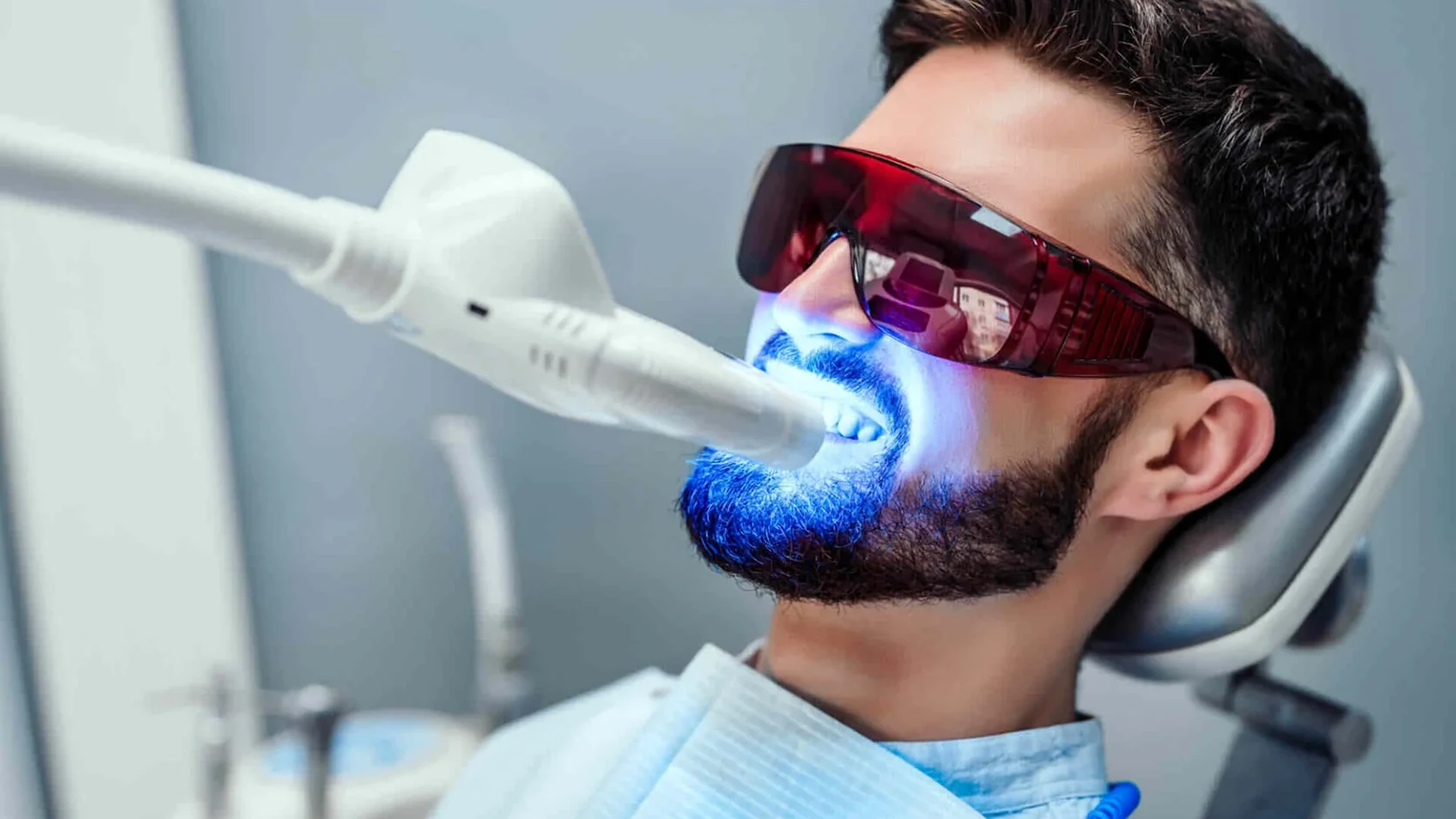
The procedure is performed entirely in the dental clinic. The dentist applies the nano whitening gel to the teeth after isolating the gums, then activates it — depending on the specific system used — with a light or laser source. The full session typically takes 45 to 90 minutes, and most patients see a visible change in shade by the end of the appointment.
Because the nano particles are smaller than those used in conventional whitening gels, they are designed to reach deeper layers of enamel and produce more even coverage across the tooth surface. This is one reason nano whitening has gained traction as an alternative to older professional whitening systems.
How nano whitening differs from laser and Zoom whitening
Patients researching whitening options in Abu Dhabi will encounter several professional techniques, laser teeth whitening, Zoom whitening, and nano whitening among them. Understanding how these differ helps set accurate expectations before committing to any one approach.
Laser vs nano teeth whitening is one of the most common comparisons patients ask about. Laser whitening uses a concentrated light beam to activate the bleaching agent on each tooth individually or across a group of teeth. It is a well-established technique that can achieve significant shade changes, but it requires more precise application and carries a slightly higher risk of post-treatment sensitivity in some patients.
Zoom whitening is a brand-name system that uses a hydrogen peroxide gel activated by a specific lamp. It is widely available and produces reliable results across multiple shade improvements. The Zoom system has been refined over several product generations, and sensitivity during or after the procedure is a common patient concern that the newer formulations have partially addressed.
Nano whitening takes a different approach — rather than relying primarily on a light or laser to drive the chemistry, it uses the particle size of the whitening agent itself to achieve deeper enamel penetration. This means the gel does more of the work independently, and the activation step is shorter or gentler in many nano whitening protocols.
| Feature | Nano Whitening | Laser Whitening | Zoom Whitening |
|---|---|---|---|
| Session duration | 45–90 minutes | 60–90 minutes | 60–90 minutes |
| Activation method | Nano-particle gel + light | Laser beam | Zoom lamp |
| Sensitivity risk | Generally low | Moderate | Low to moderate |
| Shade improvement | Several shades in one session | Several shades in one session | Several shades in one session |
| Result longevity | 6–18 months with care | 6–18 months with care | 6–18 months with care |
| Suitable for sensitive teeth | Often yes | Case dependent | Often yes |
It is worth noting that no whitening technique — nano, laser, or Zoom — can whiten dental crowns, veneers, or composite bonding. Whitening works on natural tooth enamel only. If you have existing veneers or crowns, your dentist will advise you on realistic expectations before proceeding.
Who is a good candidate for nano whitening?
Nano whitening is suitable for most adults with healthy teeth and gums who want to address extrinsic staining — discolouration caused by food, drinks, or tobacco on the outer surface of the enamel. Coffee, tea, red wine, and tobacco are the most common causes of this type of staining, and professional whitening addresses them effectively.
Patients with intrinsic staining — discolouration that originates within the tooth structure, often due to certain medications taken during tooth development, fluorosis, or trauma — may see more limited results from any whitening technique. In these cases, the dentist may recommend Emax veneers or composite bonding as more appropriate alternatives.
Nano whitening is generally well tolerated by patients with mild to moderate tooth sensitivity, though a pre-treatment assessment is important. Patients with active cavities, cracked teeth, or gum disease should have those conditions treated before whitening — attempting to whiten compromised teeth can cause pain and may worsen existing problems. A consultation at general dentistry is the appropriate starting point if you have not had a recent dental check-up.
Is nano whitening safe during pregnancy or breastfeeding?
Professional whitening, including nano whitening, is generally not recommended during pregnancy. While there is no definitive evidence of harm, most dental guidelines advise postponing elective cosmetic procedures until after delivery. If you are breastfeeding, consult your dentist, as recommendations can vary depending on the specific products used. The American Dental Association advises postponing non-emergency dental treatments during pregnancy as a precautionary measure.
The nano whitening procedure: what to expect step by step
Understanding what actually happens during a nano whitening session helps reduce any apprehension before your appointment. The process is straightforward and well tolerated by most patients.
Assessment and shade mapping. The dentist first examines your teeth and records your current shade using a clinical shade guide. This baseline measurement is what allows you to assess the actual change after treatment. Any existing issues — cavities, gum inflammation, exposed roots — are identified at this stage.
Preparation. A professional cleaning is recommended before whitening to remove plaque and surface debris that could interfere with the gel’s contact with enamel. A retractor is placed to keep the lips and cheeks away from the treatment area, and a gum barrier is applied to protect the soft tissue.
Gel application. The nano whitening gel is applied evenly across the front surfaces of the teeth. Depending on the protocol, a light source may be used to accelerate the activation. The gel is typically left in place for 15–20 minutes per application cycle, and the process may be repeated two to three times within the same appointment.
Completion and review. Once the gel is removed, the dentist compares the result against the baseline shade. Most patients experience a visible improvement of several shades. Post-care instructions are provided, and a take-home maintenance kit may be recommended to preserve the result.
How long do nano whitening results last?
The longevity of whitening results depends heavily on lifestyle habits after treatment. Patients who continue to consume staining foods and drinks frequently — coffee, tea, red wine, tomato-based sauces — and who do not maintain consistent oral hygiene will see their results fade more quickly than patients who are careful about post-treatment care.
As a general guide, results from professional whitening can last anywhere from six months to over a year. A detailed breakdown of what to do after teeth whitening covers the specific foods, drinks, and habits to prioritize in the days and weeks following treatment.
Touch-up whitening — either a shorter in-clinic session or a dentist-provided take-home tray — is the most practical way to maintain results over time without repeating a full session. Your dentist can advise on the appropriate interval based on your individual shade stability.
Nano whitening vs home whitening kits: why professional treatment matters
Over-the-counter whitening products — strips, gels, and trays available in pharmacies — are not equivalent to professional nano whitening. The key difference is the concentration of the active ingredient. Professional whitening gels used in dental clinics contain significantly higher concentrations of hydrogen or carbamide peroxide than those permitted in consumer products, which is why they produce more noticeable results in a single session.
Home kits also carry a higher risk of misuse — applying whitening gel to gums, using the product on teeth with active decay, or whitening over existing restorations — which can cause sensitivity, irritation, or uneven results. NHS dental guidance notes that teeth whitening should only be performed by a regulated dental professional or under dental supervision to ensure it is carried out safely.
Professional nano whitening at a dental clinic also includes the pre-treatment assessment, gum protection, and post-treatment guidance that home kits cannot replicate. For patients who want predictable results with minimized risk, in-clinic treatment remains the safer and more effective route.
How nano whitening fits into a broader smile improvement plan
Whitening addresses colour — it does not change the shape, size, or alignment of teeth. Patients who are happy with the shape of their teeth but want a brighter shade will often find that nano whitening alone achieves their goal. Patients who also want to address chips, gaps, or slight misalignment alongside colour improvement may benefit from a combined approach.
Composite bonding can address minor chips and edge irregularities alongside or after whitening. Composite bonding in Abu Dhabi is often used for patients who want a cost-effective, minimally invasive way to improve overall smile aesthetics beyond just shade. For patients wanting a more comprehensive transformation, a Hollywood Smile treatment plan — which typically combines whitening, veneers, and other procedures — may be the more appropriate direction.
The sequence matters: if whitening is planned alongside veneers, the whitening should be completed first so that the veneer shade is matched to the post-whitening colour of the natural teeth. Your dentist will plan the sequence appropriately during a cosmetic consultation at cosmetic dentistry.
The best teeth whitening methods in Abu Dhabi: how to choose
Abu Dhabi patients have access to several professional whitening techniques, and the right choice depends on your starting shade, tooth sensitivity history, budget, and the specific result you are aiming for. A detailed comparison is available in the guide to the best teeth whitening methods in Abu Dhabi.
For most patients with moderate staining and no significant sensitivity, nano whitening is a strong first choice — it delivers noticeable results in a single session, is generally well tolerated, and does not require multiple appointments. For patients with heavier staining or more specific cosmetic goals, a consultation will clarify whether nano whitening, laser whitening, or a combination approach is most appropriate.
Does nano whitening work on all tooth shades?
Nano whitening works most effectively on yellow and light-brown staining, which is the most common type of extrinsic discolouration. Darker brown staining, grey tones, and staining that originates within the tooth structure (intrinsic staining) respond less predictably to whitening. A dental assessment before treatment is the only reliable way to determine how well your specific discolouration will respond. Your dentist will assess the type and depth of staining and give you a realistic expectation of the likely outcome.
Can nano whitening damage tooth enamel?
When performed correctly by a qualified dental professional using appropriate product concentrations and protocols, professional whitening does not permanently damage enamel. Temporary sensitivity is the most commonly reported side effect and typically resolves within 24 to 48 hours after treatment. Overuse of whitening — either through excessively frequent professional treatments or unsupervised home use of high-concentration products — can lead to enamel changes over time. Following your dentist’s recommended schedule and maintenance plan prevents this. PubMed hosts multiple peer-reviewed studies confirming that professional whitening used within recommended parameters is considered safe for enamel.
Are you ready for a brighter smile in Abu Dhabi?
Nano whitening is one of the most accessible and effective ways to improve your smile in a single clinic visit. At Al Safwa Medical Center in Bani Yas, Abu Dhabi, the cosmetic dentistry team assesses each patient individually to confirm that whitening is appropriate and to recommend the most suitable technique for their specific situation. The starting point is a consultation — not a commitment to any procedure.
- Teeth whitening in Abu Dhabi
- Cosmetic dentistry Abu Dhabi
- Hollywood Smile Abu Dhabi
- Veneers and Emax Abu Dhabi
- Composite bonding Abu Dhabi
- Book a consultation
If you have questions about which whitening method is right for your teeth, the dental team at Al Safwa can provide a clear assessment during your first visit.
Frequently asked questions
What is nano teeth whitening and how does it work?
Nano teeth whitening is a professional in-clinic whitening technique that uses a bleaching gel formulated with nano-sized particles. These particles are engineered to penetrate tooth enamel more efficiently than standard whitening compounds, allowing the active ingredient — typically hydrogen peroxide — to work more evenly across the tooth surface. The gel is applied by a dentist after gum protection is in place, activated with a light source, and removed after a set contact time. The full procedure takes 45 to 90 minutes.
How many shades whiter can I expect from nano whitening?
The number of shades achieved varies depending on the starting colour of your teeth, the type and depth of staining, and the specific nano whitening system used. Most patients see a visible improvement of several shades in a single session. A dental assessment before treatment is the only reliable way to set accurate expectations for your specific situation.
Is nano whitening painful?
Nano whitening is not painful for most patients. Some people experience temporary tooth sensitivity during or after the procedure — this is the most commonly reported side effect and typically resolves within 24 to 48 hours. Patients with pre-existing sensitivity should inform their dentist before treatment so the protocol can be adjusted if needed.
How long does nano whitening last?
Results typically last between six months and one year, depending on dietary habits, oral hygiene routine, and whether any maintenance whitening is done. Avoiding staining foods and drinks in the 48 hours immediately after treatment helps the initial result set properly. After that, managing consumption of coffee, tea, and red wine, and maintaining regular professional cleanings, extends the longevity of the whitening effect.
What is the difference between nano whitening and Zoom whitening in Abu Dhabi?
Both are professional in-clinic whitening techniques. Zoom whitening uses a hydrogen peroxide gel activated by the Zoom lamp, a brand-specific system. Nano whitening uses a gel formulated with nano-sized particles designed for deeper enamel penetration. Both can achieve similar shade improvements. The choice between them depends on the patient’s sensitivity profile, the specific staining type, and the products available at the clinic. Your dentist will recommend the most appropriate option after an assessment.
Can I whiten my teeth if I have crowns or veneers?
Whitening agents work on natural tooth enamel only — they do not change the colour of dental crowns, veneers, bridges, or composite bonding. If you have visible restorations on your front teeth, discuss this with your dentist before whitening. Whitening the natural teeth around existing restorations can create a colour mismatch if the restorations are not also replaced or if the shade difference becomes noticeable.
