
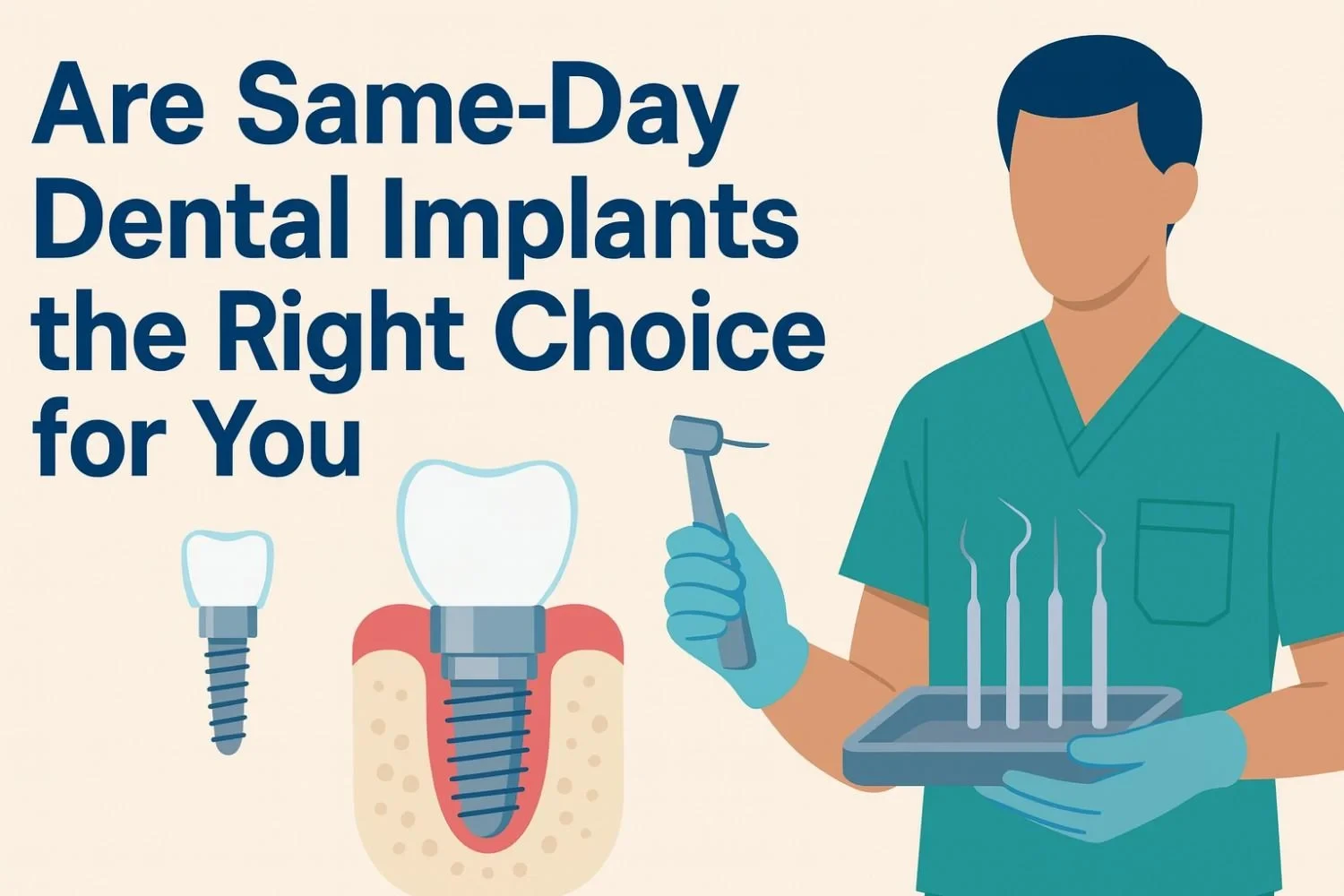
Are same-day dental implants the right choice for you?

Replacing missing teeth through same-day dental implants has become a reliable solution for patients who prefer faster restoration without waiting months for osseointegration. This approach is part of the implant and restorative treatments performed at Al Safwa Medical Center in Bani Yas, Abu Dhabi, where clinical evaluation, surgical planning, and provisional restoration are completed within a single visit when case conditions allow it. The procedure requires careful assessment of bone density, soft-tissue stability, occlusion, and periodontal health. Discussing these elements helps patients develop realistic expectations regarding durability, healing, and function.
Same-day implant care is not equivalent to placing a final crown immediately. The technique relies on placing a titanium or zirconia fixture and securing a provisional restoration while the implant integrates gradually with the bone. The method combines traditional implant protocols with immediate functional and esthetic demands often requested by adults and families seeking efficient oral rehabilitation in Abu Dhabi.
What qualifies a patient for same-day dental implants in Abu Dhabi?
Same-day implants require strict case selection. The oral surgeon evaluates anatomical and clinical indicators using CBCT imaging, periodontal charting, and restorative planning to determine whether immediate placement is safe and predictable. Case selection follows widely accepted international implant guidelines, especially regarding primary stability, socket integrity, and periodontal health.
Key clinical criteria
Patients may qualify when diagnostic findings support:
- Adequate bone density in the insertion site, particularly in the anterior maxilla or mandibular premolar/molar regions.
- Absence of active infection, such as acute abscesses, untreated periodontitis, or advanced bone loss around the site.
- Thick keratinized gingival tissue that maintains peri-implant stability.
- Controlled occlusion, ensuring the temporary crown does not receive premature forces during healing.
- Good systemic health, including non-smoking status or reduced smoking, stable glycemic levels in diabetic patients, and no recent bisphosphonate therapy.
The clinical team at Al Safwa Medical Center reviews each factor during consultation. CBCT data assist in verifying cortical bone stability, assessing sinus position, and identifying potential anatomical restrictions. The evaluation determines if immediate placement supports long-term implant survival without compromising osseointegration.
How does the same-day implant procedure work?

The workflow integrates surgical and restorative steps into one coordinated appointment. The phases below represent the method used for single-tooth immediate implants in partially edentulous patients.
Step 1: Pre-treatment evaluation
The dentist performs:
- Digital X-rays and CBCT imaging
- Periodontal cleaning if needed
- Assessment of adjacent teeth and occlusal contacts
- Shade selection for the temporary crown
The clinic frequently uses materials that comply with ADA and ISO 4049 standards, including resin-based temporary crown systems and implant-compatible impression materials.
Step 2: Tooth extraction (if required)
Atraumatic extraction techniques are used to preserve the socket walls. Specialized periotomes and luxators minimize bone compression. Bone integrity determines whether the implant can be placed immediately.
Step 3: Implant insertion
Titanium implants are inserted into the socket or prepared alveolar bone using calibrated torque values. Stability of 35–45 Ncm is preferred for immediate provisionalization. The surgeon positions the implant along the axis planned in the digital surgical guide.
Step 4: Temporary crown placement
After verifying primary stability, a provisional crown is fabricated and adjusted to eliminate functional load on the implant. The restoration maintains aesthetics while allowing bone and soft-tissue maturation.
Step 5: Follow-up
Patients return after one to two weeks for soft-tissue evaluation. Full osseointegration typically continues for three to four months before the permanent crown is placed.
Understanding the benefits and limitations
Same-day implants offer several advantages, including improved esthetics and enhanced patient comfort. The method is particularly relevant for patients in Bani Yas who prefer reduced clinical visits or have social or work-related commitments that require quicker dental rehabilitation.
Benefits
- Immediate esthetic restoration, helpful for anterior teeth
- Reduced overall treatment time
- Preservation of the socket and soft-tissue architecture
- Psychological comfort due to the absence of a visible gap
- Support for phonetics and lip profile
Limitations
- Not suitable for sites with insufficient bone density
- Requires careful postoperative compliance
- Temporary crown must remain out of occlusion
- Smokers and uncontrolled diabetics may experience reduced stability
- Risk of early implant failure if excessive mechanical load occurs
A thorough consultation with the specialists at Al Safwa Medical Center clarifies which approach is most appropriate based on clinical findings.
What makes same-day implants different from traditional implants?
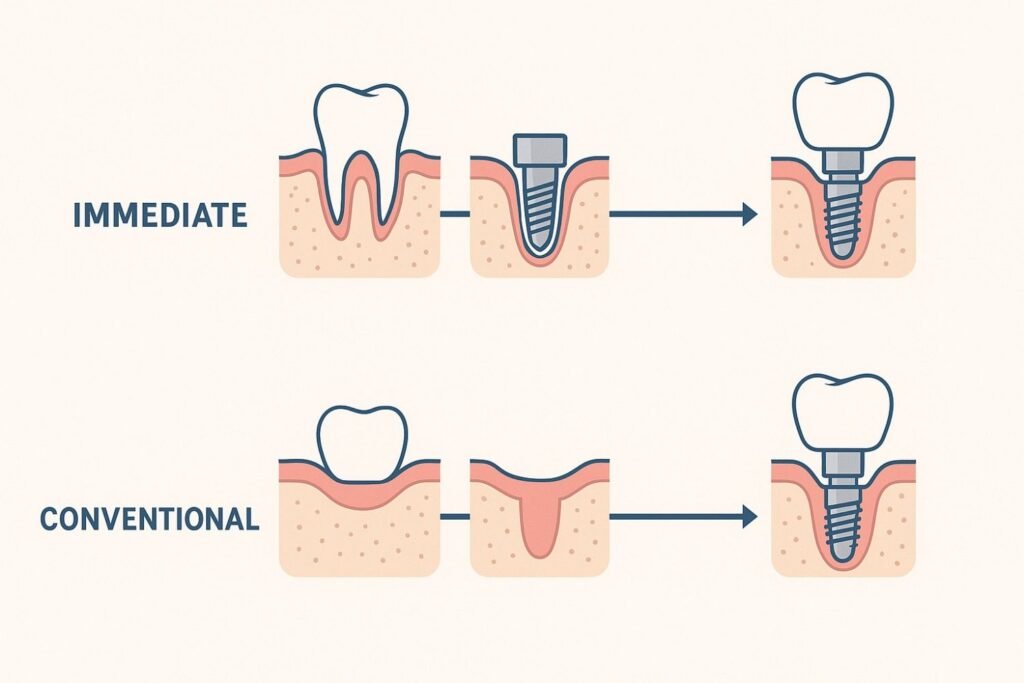
Both treatment types rely on osseointegration, yet the timing and sequence differ significantly.
Immediate approach
- Implant is placed at time of extraction
- Temporary crown is delivered the same day
- Early esthetic and functional restoration
- Internal bone remodeling occurs beneath the provisional crown
Conventional approach
- Extraction followed by healing period of 8–12 weeks
- Implant placed after soft-tissue maturation
- Final crown delivered after 3–4 months
- Predictability is high for complex cases
Immediate implants require higher initial stability and intact socket walls. Research from systematic reviews supports comparable outcomes between immediate and conventional implants when sufficient primary stability is achieved, as shown in findings from Cochrane Oral Health.
Treatment planning at Al Safwa Medical Center
The implant team includes practitioners such as Dr. Mohammed Dalloul, Dr. Saleh Salem, and Dr. Rahul Patel, who evaluate each case through diagnostic imaging and comprehensive oral examinations. The process integrates diagnostic accuracy with patient-centered planning.
Core steps in planning
- Assessment of medical history including medications, allergies, and systemic conditions.
- Periodontal examination to confirm absence of active gum disease.
- Radiographic evaluation through CBCT imaging.
- Determination of implant size, angulation, and insertion depth.
- Occlusal analysis ensures functional harmony and stability.
- Soft-tissue evaluation to identify keratinized gingiva adequacy.
Treatment plans usually consist of individualized timelines and postoperative protocols to maintain osseointegration.
Does the procedure hurt? What to expect during recovery

The surgical phase is performed under local anesthesia. Most patients report pressure sensations rather than sharp pain. Immediately after surgery, mild swelling or sensitivity can occur. These reactions are normal and typically respond well to standard postoperative medications.
Recovery instructions
- Use prescribed analgesics for 24–48 hours
- Maintain soft diet during initial healing
- Avoid biting with the provisional crown
- Rinse with chlorhexidine mouthwash as recommended
- Continue routine brushing while avoiding the surgical site
- Attend scheduled follow-up appointments
- Avoid smoking to prevent delayed healing
Postoperative care is critical for case success. Patients are encouraged to maintain communication with their treating dentist if any unusual symptoms occur such as prolonged bleeding, severe pain, or mobility in the provisional crown.
How durable are same-day dental implants
Implant success rates depend on bone quality, oral hygiene, systemic health, and mechanical forces applied during healing. Daily hygiene routines aligned with CDC guidelines support long-term implant stability by reducing plaque accumulation and maintaining healthy peri-implant tissue. Immediate implants can last many years when placed in suitable conditions and maintained with appropriate home-care routines. Research shows that immediate implant placement demonstrates comparable survival rates to conventional methods when executed with correct case selection and adequate primary stability.
Regular maintenance appointments at Al Safwa Medical Center include professional scaling, radiographic evaluations, and occlusal adjustments. Implant-supported restorations require the same daily care as natural teeth, including brushing, interdental cleaning, and monitoring for signs of gum inflammation.
Case examples commonly treated at Al Safwa Medical Center
-
Single missing anterior tooth
An immediate implant can preserve the papilla and support the gingival contour, creating a natural appearance once the final crown is placed.
-
Posterior tooth replacement
Patients with fractured premolars or first molars may qualify for same-day placement when bone quality is favorable.
-
Implant replacement for failed root canal cases
Teeth with complex fractures or non-restorable endodontic conditions may be removed and replaced immediately with careful socket management.
Each case requires individualized assessment. The doctors evaluate periodontal health, occlusal requirements, and long-term prognosis before approving immediate placement.
Conclusion
Same-day dental implants provide a predictable and efficient option for replacing missing teeth when anatomical and periodontal conditions support immediate placement. The method combines surgical stability with esthetic comfort, helping patients return to daily activities without extended waiting periods. The team at Al Safwa Medical Center in Bani Yas, Abu Dhabi evaluates each case using clinical guidelines, CBCT imaging, and structured diagnostic protocols to ensure treatment safety and effectiveness. Patients who wish to explore implant-based restoration can consult the clinic for detailed assessments and tailored treatment planning.
