
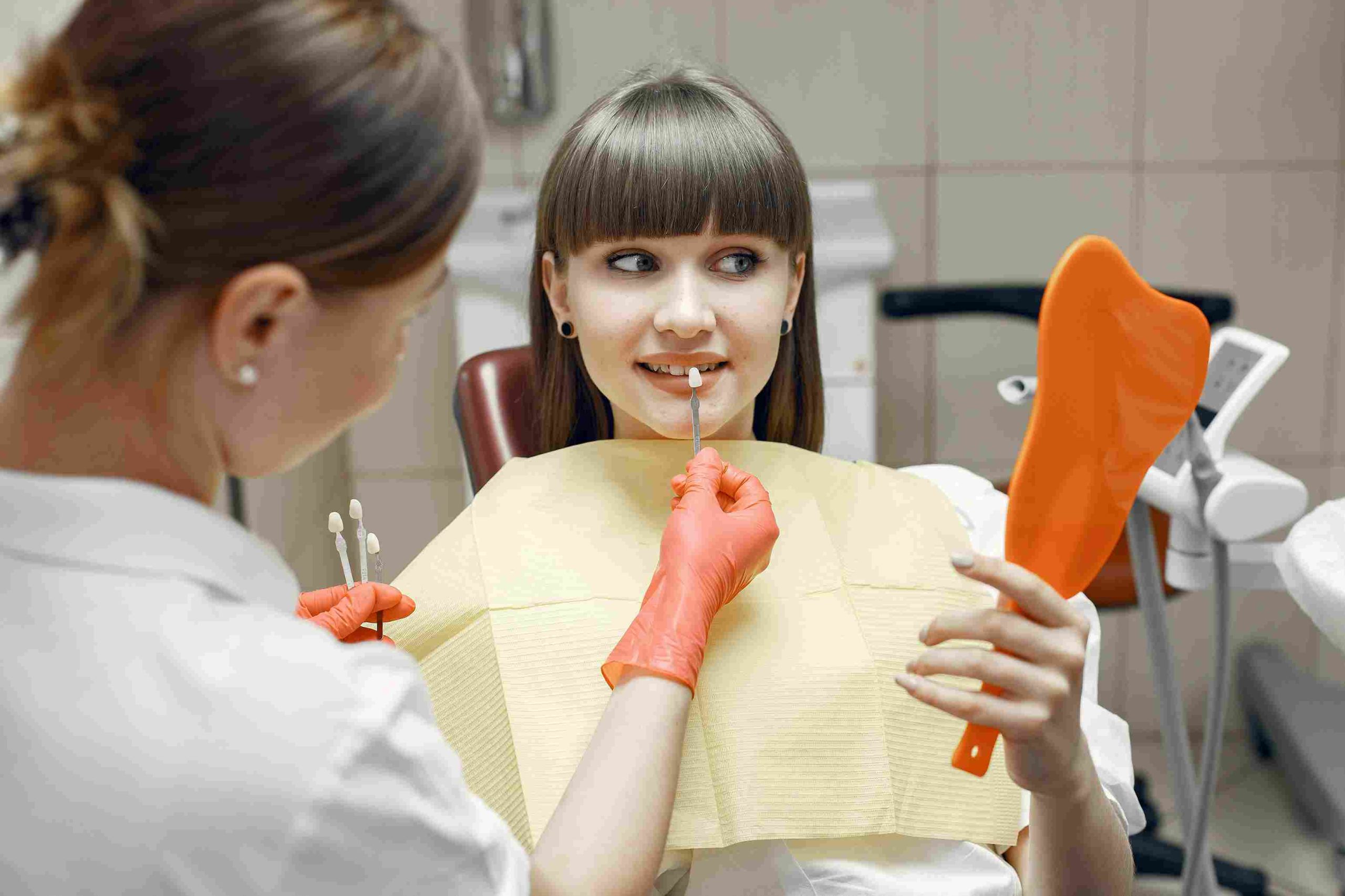
Choosing veneers Abu Dhabi is not only about picking a whiter shade. The material matters because each veneer type behaves differently with light, tooth color, bite pressure, gum shape, and the amount of tooth preparation needed.
Emax veneers Abu Dhabi may suit patients who want a natural-looking smile with good translucency. Porcelain veneers can work well for many cosmetic smile concerns, especially when the goal is to improve shape, color, and symmetry. Zirconia veneers may be considered when extra strength or stronger color masking is needed. A smile makeover Abu Dhabi may include veneers, but it may also need whitening, crowns, gum treatment, or orthodontics before the final result looks balanced.
This guide explains the main types of veneers, when each one may be suitable, and when veneers may not be the right first step.
What are dental veneers?
Dental veneers are thin shells placed on the front surface of teeth to improve their shape, color, size, or alignment. They are commonly used for visible front teeth, especially when the patient wants a more even and balanced smile.
Veneers may help improve:
- Deep stains that do not respond well to whitening
- Small gaps between front teeth
- Mild tooth wear
- Small chips
- Uneven tooth edges
- Slight differences in tooth size
- Mild shape irregularities
- Smile color and symmetry
Veneers are part of cosmetic dentistry in Abu Dhabi, but they are not suitable for every dental problem. If a tooth has severe decay, a large old filling, a fracture, or weak structure, a crown may be more suitable than a veneer. If the teeth are crowded or the bite is unstable, orthodontic treatment may be needed before cosmetic work.
The best veneer plan starts with oral health first. The dentist checks the teeth, gums, bite, enamel thickness, and smile line before recommending Emax, porcelain, zirconia, or another option.
What is the difference between Emax, porcelain, and zirconia veneers?
The main difference is the material. Each material has its own balance of translucency, strength, thickness, and ability to cover the natural tooth color.
| Veneer type | Main strength | Best suited for | Important note |
| Emax veneers | Natural appearance and good strength | Front teeth, natural smile design, mild to moderate discoloration | Needs careful shade planning |
| Porcelain veneers | Highly aesthetic and customizable | Shape, color, gaps, and smile balance | Can chip if bite pressure is high |
| Zirconia veneers | Higher strength and stronger color masking | Darker teeth, stronger support, selected complex cases | May look less translucent in some cases |
| Smile makeover | Full smile planning | Patients needing more than one cosmetic treatment | Not one material or one fixed treatment |
All three can look good when used correctly. The right choice depends on your natural tooth color, enamel, bite, gum line, and how much change you want.
When are Emax veneers the right choice?
Emax veneers Abu Dhabi are often chosen for front teeth because they combine strength with a natural-looking level of translucency. Emax is a type of lithium disilicate ceramic, commonly used in cosmetic dentistry because it can reflect light in a way that resembles natural enamel.
Emax veneers may be suitable if you have:
- Mild to moderate discoloration
- Small gaps between front teeth
- Slightly uneven tooth edges
- Small chips
- Teeth that need better symmetry
- A desire for a natural-looking smile
- Enough enamel for bonding
- Healthy gums and stable oral health
Emax is often useful when the patient does not want a flat, overly white look. It can be shaped and shaded to blend with the face, lips, and surrounding teeth.
Still, Emax is not always the best choice. If the underlying tooth is very dark, the translucency that makes Emax look natural may also allow some darkness to show through. If the patient has heavy grinding or strong bite pressure, the dentist may need to evaluate whether veneers are safe or whether crowns, bite treatment, or a night guard are needed.
Patients considering veneers and Emax in Abu Dhabi should ask about shade, thickness, tooth preparation, and long-term care before starting treatment.
When are porcelain veneers the right choice?
Porcelain veneers are a common choice for improving the color, shape, and symmetry of front teeth. They can be customized in shade, translucency, texture, and contour, which makes them useful for many cosmetic cases.
Porcelain veneers may be suitable when the patient has:
- Uneven tooth color
- Stains that do not improve enough with whitening
- Minor spaces
- Slight wear
- Small chips
- Uneven tooth length
- A desire for a brighter but still natural smile
Porcelain can offer very good cosmetic results when the teeth are healthy and the bite is controlled. The material can be made to look soft and natural or brighter and more uniform, depending on the patient’s preference and the dentist’s plan.
However, porcelain veneers still need protection. They can chip or fracture if the patient bites hard objects, grinds heavily, or has an unstable bite. If the patient has bruxism, the dentist may recommend a night guard after treatment.
Another important point is tooth preparation. Some veneer cases require removing a thin layer of enamel so the veneer does not look bulky. According to the American Dental Association, veneers may require removal of some enamel, and this means the treatment can be irreversible in many cases.
When are zirconia veneers the right choice?
Zirconia veneers may be considered when a case needs more strength or stronger masking of the tooth color. Zirconia is known for high durability and is often used in crowns and other restorations. In selected veneer cases, it may help when the tooth underneath is darker or when the case needs a stronger material.
Zirconia veneers may be suitable when:
- The natural tooth color is dark
- More masking is needed
- There are old restorations or color differences
- More strength is required
- The teeth need stronger coverage
- The case does not depend mainly on high translucency
The main tradeoff is appearance. Zirconia can be less translucent than Emax or some porcelain options. This does not mean it looks unnatural, but it needs careful design, shade selection, and laboratory work. For highly visible front teeth, the dentist may choose another material if translucency and light reflection are more important than masking power.
In some cases, if the tooth is weak, heavily restored, or structurally damaged, a dental crown may be more appropriate than a zirconia veneer. A crown covers more of the tooth and can provide better protection when the remaining tooth structure is limited.
Which veneer type looks most natural?
The most natural-looking veneer is not always one specific material. Natural appearance depends on how the veneer matches your tooth shape, gum line, lip movement, face, and smile style.
Emax and porcelain are often used for natural-looking front teeth because they can offer good translucency. This helps the veneer interact with light in a way that is closer to enamel.
Zirconia may be less translucent in some cases, but it can still look attractive when designed well. It may be more useful when the underlying tooth color needs stronger coverage.
Natural results depend on:
- Shade selection
- Tooth proportions
- Surface texture
- Gum symmetry
- Smile line
- Tooth preparation
- Material thickness
- Laboratory quality
- Bite adjustment
A natural smile is not only white. It has depth, shape, balance, and a color that suits the patient’s face. For many patients, a slightly softer shade looks better than the brightest possible shade.
Is a smile makeover the same as veneers?
A smile makeover Abu Dhabi is not the same as veneers. Veneers may be part of a smile makeover, but the full plan may include several treatments.
A smile makeover may involve:
- Emax veneers
- Porcelain veneers
- Zirconia veneers
- Teeth whitening
- Gum treatment
- Gum reshaping
- Dental crowns
- Orthodontics
- Invisalign
- Replacement of old restorations
- Bite correction
For example, a patient with yellow teeth but good shape may only need teeth whitening. A patient with crowded teeth may need orthodontics first. A patient with weak or heavily filled front teeth may need crowns instead of veneers.
A good smile makeover should not force every patient into the same design. It should match the teeth, gums, bite, face shape, and oral health.
Who is a good candidate for veneers?
A good candidate for veneers usually has healthy teeth and gums, enough enamel for bonding, and cosmetic concerns that can be corrected by covering the front surface of the teeth.
You may be a good candidate if you have:
- Healthy gums
- No active tooth decay
- Enough enamel
- Mild to moderate cosmetic concerns
- Stable bite
- No severe grinding, or grinding that can be managed
- Realistic expectations
- Good oral hygiene
- Commitment to regular dental visits
Veneers are often suitable when the problem is mainly cosmetic. They are less suitable when the tooth needs structural repair or when the bite would place too much pressure on the veneers.
Who should avoid veneers or delay treatment?
Some patients should avoid veneers until underlying dental problems are treated. Placing veneers over unhealthy teeth or gums can create long-term problems, even if the smile looks better at first.
Veneers may need to be delayed if you have:
- Untreated cavities
- Gum disease
- Bleeding or swollen gums
- Severe teeth grinding
- A very deep bite
- Large cracks
- Large fillings in front teeth
- Weak enamel
- Severe crowding
- Poor oral hygiene
- Unrealistic expectations about color or shape
In these cases, treatment may start with gum disease treatment, fillings, orthodontics, bite correction, or crowns. The goal is to build a healthy foundation before cosmetic treatment.
Can veneers be done without shaving teeth?
Some cases can be treated with minimal-prep or no-prep veneers, but this is not suitable for everyone.
No-prep veneers may work when:
- Teeth are slightly small
- There are small spaces
- The teeth are not too forward
- Only a mild shape change is needed
- The tooth color does not need strong masking
- The bite is favorable
If the teeth are already large, bulky, or protruded, adding veneers without preparation can make them look too thick. If the tooth color is dark, a very thin veneer may not cover it well. If the bite is tight, no-prep veneers may be more likely to chip.
This is why “no shaving” should not be the main goal. The better goal is conservative planning, which means preserving as much healthy tooth structure as possible while still creating a natural and stable result.
How long do veneers last?
Veneers can last for many years with proper care, but they are not permanent for life. They may need repair or replacement if they chip, loosen, wear, stain at the edges, or if the gum line changes.
The lifespan of veneers depends on:
- Material selection
- Bonding quality
- Tooth preparation
- Bite pressure
- Grinding habits
- Oral hygiene
- Gum health
- Diet and daily habits
- Regular checkups
- Use of a night guard when needed
Cleveland Clinic notes that veneers can chip, crack, or loosen and may need replacement over time. This is why veneers should be treated as long-term dental restorations that require care, not as a one-time cosmetic product.
How do you care for veneers?
Veneers should be cared for like natural teeth, with some added caution. The veneer surface does not decay, but the tooth underneath and the gum around it still need daily care.
To protect your veneers:
- Brush twice daily.
- Floss every day.
- Avoid biting nails, pens, or hard objects.
- Do not use teeth to open packages.
- Avoid chewing ice.
- Treat gum bleeding early.
- Wear a night guard if recommended.
- Avoid heavy pressure on front teeth.
- Attend routine checkups.
- Schedule professional teeth cleaning.
Good cleaning protects the margins between the veneer and the tooth. This helps reduce the risk of gum inflammation, staining at the edges, and decay around the restoration.
When is whitening better than veneers?
Whitening may be better than veneers if the main issue is tooth color and the shape of the teeth is already good.
Whitening may be enough when:
- Teeth are well shaped
- Alignment is acceptable
- There are no major gaps
- The concern is mostly yellowing
- Stains are likely to respond to whitening
- The patient wants a non-invasive first step
Veneers are usually considered when the concern includes shape, size, gaps, wear, or stains that do not respond well to whitening. Some smile plans begin with whitening before veneers so the dentist can match the veneers to a brighter natural tooth shade.
When is orthodontics better than veneers?
Veneers can improve the appearance of mild alignment issues, but they do not move teeth. If the teeth are crowded, protruded, rotated, or affected by bite problems, orthodontics may be the better first step.
Orthodontics may be needed when there is:
- Moderate or severe crowding
- Deep bite
- Open bite
- Crossbite
- Large gaps
- Midline mismatch
- Tooth rotation
- Excessive pressure on front teeth
Some patients choose Invisalign in Abu Dhabi before veneers. This can place the teeth in a better position, reduce the amount of enamel preparation needed, and create a more stable cosmetic result.
How should you choose the right veneer type in Abu Dhabi?
Choosing between Emax, porcelain, and zirconia should be based on diagnosis, not only on the name of the material.
The dentist usually considers:
- Tooth color
- Enamel thickness
- Gum health
- Smile line
- Tooth shape
- Bite pressure
- Grinding habits
- Number of teeth being treated
- Desired shade
- Need for masking
- Need for strength
- Patient expectations
If you want a very natural look and your tooth color is not too dark, Emax or porcelain may be suitable. If you need stronger masking or more strength, zirconia may be considered. If your teeth need more structural support, crowns may be safer than veneers.
At Al Safwa Medical Center in Bani Yas, Abu Dhabi, patients can discuss veneer options as part of a full cosmetic dental evaluation. This helps match the treatment to the condition of the teeth, not only to a reference photo.
Plan your veneers around your teeth, not a template
The right choice between Emax veneers Abu Dhabi, porcelain veneers, and zirconia veneers depends on your tooth color, enamel, bite, gum health, and cosmetic goals. Emax often suits natural-looking front teeth, porcelain is highly customizable, and zirconia may help when strength or stronger masking is needed.
If you are considering veneers Abu Dhabi or a smile makeover Abu Dhabi, start with a dental evaluation rather than choosing a material first. At Al Safwa Medical Center, the dental team can assess your teeth and explain whether veneers and Emax, whitening, crowns, gum treatment, or orthodontics are the right path.
You can contact Al Safwa Medical Center to book a cosmetic dental consultation and choose a veneer plan that suits your smile safely and realistically.
FAQ
What is the best type of veneer for front teeth?
Emax and porcelain veneers are often used for front teeth because they can offer natural translucency and detailed shade matching. The best option depends on tooth color, enamel, bite, and the desired smile design.
Are Emax veneers better than porcelain veneers?
Emax veneers are strong and natural-looking, but they are not automatically better for every case. Porcelain veneers can also provide excellent aesthetics. The choice depends on the tooth condition and cosmetic goal.
When are zirconia veneers recommended?
Zirconia veneers may be recommended when stronger masking or more strength is needed. They may suit darker teeth or selected complex cases, but they may be less translucent than Emax or porcelain.
Is a smile makeover only veneers?
No. A smile makeover may include veneers, whitening, crowns, gum treatment, orthodontics, or Invisalign. The treatment plan depends on the condition of the teeth and gums.
Can veneers damage natural teeth?
Veneers require careful planning. Some cases need removal of a thin layer of enamel, which can make the treatment irreversible. Healthy teeth, good bonding, and proper bite planning reduce the risk of problems.
