
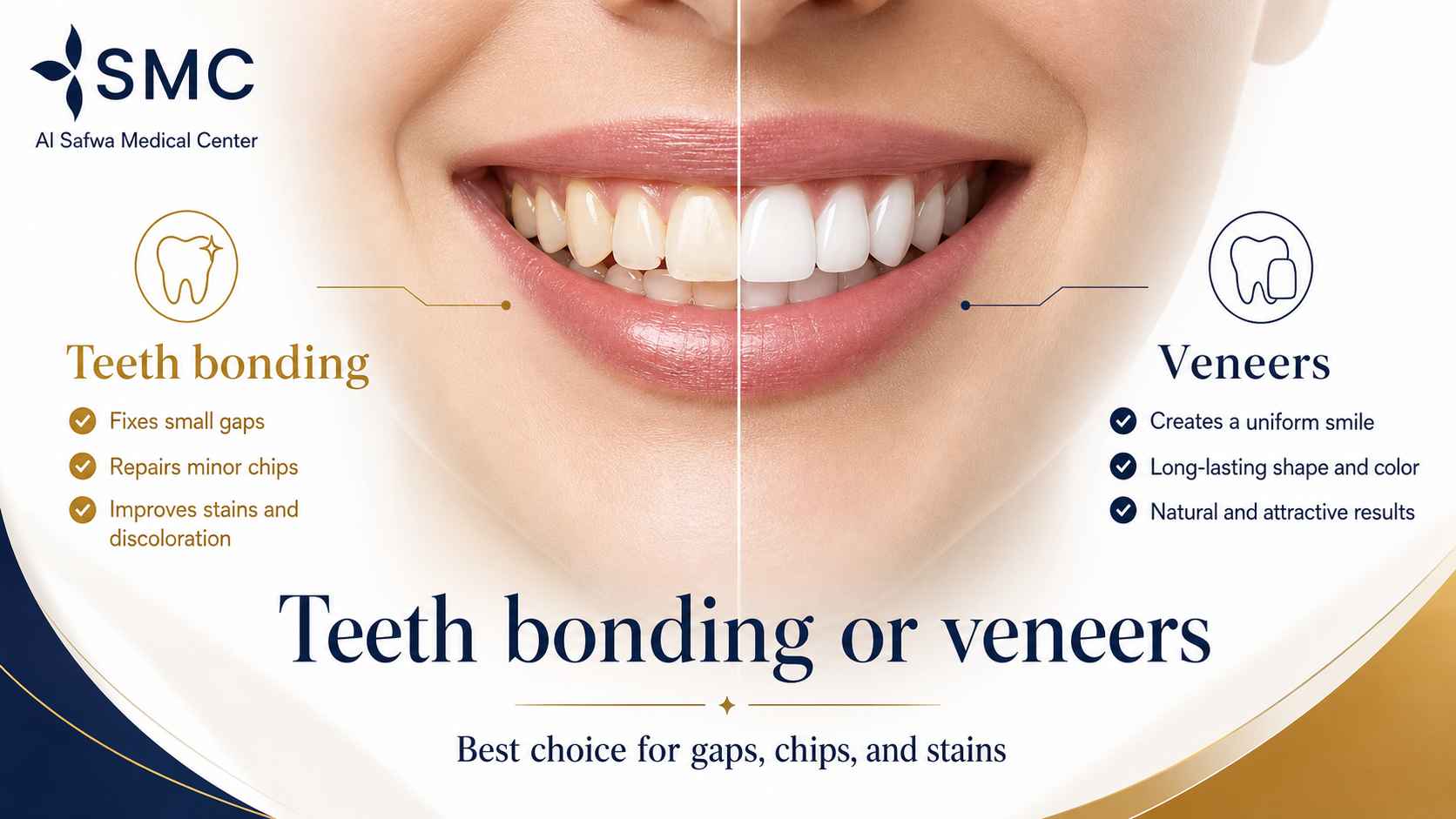
Small gaps, chipped edges, and stubborn stains can change the way your smile looks, even when your teeth are generally healthy. If you are comparing teeth bonding Abu Dhabi and veneers Abu Dhabi, the right choice depends on the size of the problem, your tooth structure, your bite, your budget, and how long you want the result to last.
Composite bonding is a direct cosmetic treatment where tooth-colored resin is shaped on the tooth in the clinic. Veneers are thin shells, usually made from porcelain or Emax, that are bonded to the front surface of teeth after careful planning. Bonding is often better for small repairs and conservative changes. Veneers are often better for deeper stains, multiple gaps, worn edges, and a more complete smile improvement.
This guide explains when bonding works well, when veneers are more suitable, and how to choose the right option to fix gaps teeth, chips, and discoloration through cosmetic dentistry in Abu Dhabi.
What is teeth bonding?
Teeth bonding, also called composite bonding, uses a tooth-colored resin material to repair or reshape the visible part of a tooth. The dentist applies the composite directly to the tooth, shapes it, hardens it with a curing light, and polishes it so it blends with nearby teeth.
Bonding can be used to improve:
- Small gaps between teeth
- Minor chips
- Uneven tooth edges
- Small areas of discoloration
- Slight shape differences
- Mild tooth wear
- Small cosmetic defects in one or more teeth
The main advantage of bonding is that it is conservative. In many cases, little or no enamel removal is needed. It is also usually faster than veneers and may be completed in one visit, depending on the number of teeth treated.
However, bonding has limits. Composite resin can stain, wear, chip, or lose polish over time. It may also not reflect light in the same way as porcelain or Emax veneers. This is why bonding is often best for smaller cosmetic corrections, not full smile transformations.
What are veneers?
Veneers are thin shells placed on the front surface of teeth to improve color, shape, size, and overall smile balance. They are usually made from porcelain, Emax, or other ceramic materials.
Veneers and Emax in Abu Dhabi are often used when the patient wants a more stable cosmetic result across several front teeth. Veneers can cover deeper discoloration, close small to moderate gaps, improve worn edges, and create a more even smile.
Veneers may be suitable for:
- Stains that do not respond well to whitening
- Several visible gaps
- Uneven tooth size
- Worn or short-looking teeth
- Mild chips across several teeth
- A more complete cosmetic smile plan
- Long-term shade and shape improvement
Veneers may require removing a thin layer of enamel in some cases so the final result does not look bulky. This is why they should be planned carefully. According to the American Dental Association, veneers may require enamel removal, which can make the treatment irreversible in many cases.
Teeth bonding vs veneers: what is the main difference?
The main difference is the material and how the treatment is made. Bonding is shaped directly on the tooth using composite resin. Veneers are custom-made shells that are bonded to the front of the teeth.
| Comparison point | Teeth bonding | Veneers |
| Material | Composite resin | Porcelain, Emax, or ceramic |
| Treatment time | Often faster | Usually needs more planning and visits |
| Tooth preparation | Minimal in many cases | May need enamel preparation |
| Best for | Small gaps, chips, and minor changes | Larger cosmetic changes and multiple teeth |
| Stain resistance | Lower than veneers | Higher than composite bonding |
| Repair | Easier to repair | May need replacement if damaged |
| Longevity | Good, but usually shorter | Often longer with good care |
| Cost | Usually lower | Usually higher |
| Appearance | Good for small corrections | Often more stable for full smile design |
Neither option is automatically better. The better treatment is the one that matches the size of the problem and the condition of the teeth.
Which is better to fix gaps between teeth?
If you want to fix gaps teeth, the best treatment depends on the size and cause of the gap.
Composite bonding may be suitable for small gaps, especially between front teeth. The dentist can add composite to the sides of the teeth and shape it to close the space naturally. This can be a good option when the teeth are otherwise healthy, well aligned, and close to the desired color.
Bonding may be suitable for gaps when:
- The gap is small
- Only one or two spaces need correction
- The teeth are not severely misaligned
- The bite is stable
- The patient wants a conservative option
- The tooth color is already acceptable
Veneers may be better when the gaps are larger, multiple, or combined with other cosmetic concerns such as stains, worn edges, or uneven tooth shapes. Veneers can redesign the proportions of several teeth at once, which may create a more balanced smile.
Veneers may be better for gaps when:
- Several gaps are visible
- Tooth size needs correction
- Teeth look too small or narrow
- The patient wants a wider smile change
- There is also staining or uneven shape
- Long-term color stability is important
In some cases, neither bonding nor veneers should be the first step. If the gaps are caused by tooth position, bite issues, or larger spacing, orthodontics in Abu Dhabi or Invisalign may be more suitable before cosmetic treatment.
Which is better for chipped teeth?
For small chips, bonding is often a practical first option. It can rebuild a chipped edge quickly and preserve healthy tooth structure.
Bonding may work well when the chip is:
- Small
- Limited to the edge of the tooth
- Not caused by a major fracture
- Not painful
- Not exposing deeper tooth layers
- Not linked to heavy grinding
- Affecting one tooth only
The dentist can match the composite shade to the tooth, rebuild the missing part, and polish it. If the bonding chips later, it is usually easier to repair than a veneer.
Veneers may be better when chips are larger, repeated, or part of a wider smile concern. For example, if several front teeth are worn, uneven, and stained, veneers may create a stronger and more consistent cosmetic result.
Veneers may be considered when:
- Several teeth have chipped edges
- The front teeth are worn down
- The patient wants a more even smile line
- Bonding has failed repeatedly
- Chips are combined with discoloration
- The overall tooth shape needs redesign
If the chip is large or the tooth is structurally weak, a veneer may still not be enough. In that case, dental crowns may be more suitable because they cover and protect more of the tooth.
Which is better for stains and discoloration?
Stains need careful diagnosis before choosing bonding or veneers. Some discoloration is external and may improve with cleaning or whitening. Other stains are deeper and may need cosmetic coverage.
Before bonding or veneers, the dentist may recommend teeth whitening in Abu Dhabi if the main concern is yellowing and the tooth shape is already good.
Bonding may help with stains when:
- The stain is small
- Only one tooth has a visible mark
- The discoloration is mild
- The patient wants a conservative repair
- The tooth does not need a full front-surface cover
However, composite can stain over time, especially with coffee, tea, smoking, and dark-colored foods. It may need polishing or replacement later.
Veneers are often better for deeper or more widespread discoloration. Porcelain and Emax are more stain-resistant than composite and can provide a more stable color over time.
Veneers may be better when:
- Stains are deep
- Whitening did not give enough improvement
- Several teeth are discolored
- Color and shape both need improvement
- The patient wants a more uniform smile
- Long-term shade stability matters
For patients with existing fillings, crowns, or veneers in the smile area, whitening and cosmetic planning should be done carefully because restorations do not whiten like natural teeth.
Which looks more natural?
Both bonding and veneers can look natural when used in the right case. The difference is that veneers often provide better light reflection and long-term color stability, while bonding depends strongly on the dentist’s chairside shaping and polishing.
A natural-looking result depends on:
- Shade matching
- Tooth proportions
- Gum line
- Smile line
- Surface texture
- Edge shape
- Tooth translucency
- Bite contact
- Number of teeth treated
Bonding can look very natural for a small repair on one tooth. Veneers can look more balanced when several teeth need to be changed together.
The goal should not be the brightest shade possible. A natural smile usually fits the face, lips, age, gum shape, and surrounding teeth.
Which lasts longer?
Veneers usually last longer than composite bonding, especially when the patient has good oral hygiene, a stable bite, and no heavy grinding. Veneers also resist stains better than composite resin.
Bonding may need maintenance earlier, such as:
- Polishing
- Edge repair
- Color refresh
- Small chip repair
- Replacement of worn areas
Veneers can last for many years, but they are not permanent for life. They can chip, loosen, crack, or need replacement if the bite is strong, if the patient grinds their teeth, or if the teeth and gums are not maintained.
Cleveland Clinic notes that veneers may chip, crack, loosen, or need replacement over time. This is why veneers should be treated as long-term restorations that need care, not as a one-time cosmetic product.
Which is less invasive?
Bonding is usually less invasive than veneers. Many bonding cases require little or no enamel removal, which makes it a more conservative choice for small cosmetic concerns.
Veneers may require removing a thin layer of enamel. This helps the veneer fit naturally without making the tooth look too thick. The amount of preparation depends on the tooth position, desired color change, veneer material, and final smile design.
For patients who want the most conservative option, bonding may be the better first step. But conservative does not always mean best. If the case needs a major change in color, shape, or symmetry, too much composite may look bulky or may not last as well.
A good treatment plan asks: what is the least invasive option that can still give a stable and realistic result?
Who is a good candidate for teeth bonding?
You may be a good candidate for teeth bonding Abu Dhabi if your concern is small, your teeth are healthy, and you want a conservative cosmetic improvement.
Bonding may suit you if you have:
- A small chip
- A minor gap
- Mild uneven edges
- One tooth with a small stain
- Good oral hygiene
- Healthy gums
- A stable bite
- No severe grinding
- A preference for a faster option
- Realistic expectations about maintenance
Bonding may also suit patients who want to improve a small area before committing to a more permanent cosmetic treatment later.
Who is a good candidate for veneers?
You may be a good candidate for veneers Abu Dhabi if you want a more complete improvement in tooth color, shape, and symmetry, and your teeth and gums are healthy enough for the procedure.
Veneers may suit you if you have:
- Multiple stained front teeth
- Small to moderate gaps
- Uneven tooth size
- Worn edges
- Minor chips across several teeth
- A desire for more stable color
- Enough enamel for bonding
- Healthy gums
- No untreated decay
- A stable bite
- Realistic cosmetic goals
Veneers are often part of a wider smile plan through cosmetic dentistry. The plan may also include whitening, gum treatment, crowns, or orthodontics depending on the case.
When should bonding or veneers be delayed?
Bonding and veneers should not be placed over untreated dental problems. Cosmetic treatment looks better and lasts longer when the foundation is healthy.
Treatment may need to be delayed if you have:
- Untreated cavities
- Gum disease
- Bleeding gums
- Heavy tartar buildup
- Severe sensitivity
- Cracked teeth
- Large old fillings
- Weak enamel
- Severe crowding
- Deep bite
- Strong clenching or grinding
- Pain that has not been diagnosed
In these situations, the dentist may recommend gum disease treatment, fillings, orthodontics, crowns, or professional cleaning before cosmetic treatment.
Is bonding or veneers better for younger patients?
For teenagers or younger patients, bonding is often considered before veneers when the issue is small, such as a chipped front tooth. This is because bonding is usually more conservative and easier to adjust as the teeth and gums continue to mature.
Veneers are usually planned more carefully in younger patients because they may involve enamel preparation and long-term maintenance. If tooth position is still changing, orthodontic treatment may be considered first.
For children or teenagers with chipped or injured teeth, the dentist may also consider the patient’s age, bite, tooth development, and habits. In some cases, pediatric dentistry or orthodontic evaluation may be needed before cosmetic treatment.
How do you care for bonding and veneers?
Both bonding and veneers need daily care. The material may be artificial, but the tooth and gum around it are still natural.
To protect bonding and veneers:
- Brush twice daily.
- Floss every day.
- Avoid biting nails or pens.
- Do not use teeth to open packages.
- Avoid chewing ice.
- Reduce staining drinks if you have bonding.
- Wear a night guard if you grind your teeth.
- Treat gum bleeding early.
- Visit the dentist for routine checkups.
- Schedule professional teeth cleaning.
Bonding may need polishing from time to time. Veneers need monitoring around the margins, gums, and bite contact.
How does a dentist choose between bonding and veneers?
The dentist will not choose based only on the final look you want. The decision depends on the condition of the teeth and how much change is needed.
Before recommending treatment, the dentist may check:
- Size of the gap or chip
- Type of stain
- Tooth color
- Enamel thickness
- Gum health
- Bite pressure
- Grinding habits
- Number of teeth involved
- Existing fillings or crowns
- Smile line
- Patient expectations
- Maintenance needs
If the change is small, bonding may be enough. If the change involves several teeth, deeper discoloration, or a more complete smile design, veneers may be more suitable.
At Al Safwa Medical Center in Bani Yas, Abu Dhabi, patients can discuss both options after a dental exam and choose a plan based on oral health, not only cosmetic preference.
Choose based on the size of the problem, not only the final photo
The choice between teeth bonding Abu Dhabi and veneers Abu Dhabi depends on what your teeth actually need. Composite bonding is often better for small gaps, minor chips, and limited corrections. Veneers are often better for deeper stains, multiple teeth, and more complete smile changes.
If you want to fix gaps teeth, repair chipped edges, or improve discoloration through cosmetic dentistry in Abu Dhabi, start with a proper dental evaluation. At Al Safwa Medical Center, the dental team can assess your teeth, gums, bite, and cosmetic goals before recommending bonding, veneers, whitening, crowns, or orthodontics.
You can contact Al Safwa Medical Center to book a cosmetic dental consultation and choose the option that fits your smile safely and realistically.
FAQ
Is teeth bonding better than veneers?
Teeth bonding is often better for small chips, minor gaps, and conservative changes. Veneers are often better for deeper stains, multiple teeth, and a more complete smile improvement.
Can composite bonding fix gaps between teeth?
Yes, composite bonding can fix small gaps between teeth when the teeth are healthy and the bite is stable. Larger gaps may need veneers, orthodontics, or Invisalign.
Do veneers last longer than bonding?
Veneers usually last longer and resist stains better than bonding. Bonding is easier to repair, but it may need polishing, touch-ups, or replacement sooner.
Does teeth bonding stain?
Yes, bonding can stain over time, especially with coffee, tea, smoking, and dark-colored foods. Polishing can help, but some bonding may need replacement later.
Which is better for stains, bonding or veneers?
Bonding may work for a small stain on one tooth. Veneers are often better for deeper or wider discoloration, especially when whitening does not give enough improvement.
